
Minnesota State Symbols
Compiled by the Minnesota Legislative Reference Library
These Minnesota state symbols are designated by law. The list includes statutory citations, some legislative history, and citations to sources of additional information available in the Legislative Reference Library. The Library also has a list of unofficial or proposed symbols, both serious and facetious. These online lists are supplemented with notebooks of additional news clippings and other materials in the Library.
For more information about official state symbols, see the State Symbols from the Office of the Secretary of State and a state symbols fact sheet from the Minnesota House of Representatives Public Information Services Office. Or test your knowledge with a state symbols game from House Public Information Services.
Bird
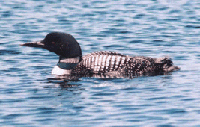
The loon (Gavia immer) was designated in 1961 (see Minnesota Statutes 1.145).
Before the Legislature decided on the loon as Minnesota's state bird, several other birds were suggested, including the Eastern goldfinch (1947), the mourning dove (1951), the pileated woodpecker (1951 and 1953), the scarlet tanager (1951) and the wood duck (1951).
The successful 1961 bill was authored by Sen. Norman Walz and Rep. Loren Rutter, and was signed into law by Governor Elmer L. Andersen.
Learn more:
- Bachmann, Elizabeth M. "Minnesota's New State Bird, the Loon." Gopher Historian, Fall 1961): 17-22. Used with permission.
- Hubbell, Sue. "Its Ponds May Not Always be Golden, But the Loon Still Sings a Wild Song." Smithsonian, March 1989: 58-66.
- Loon: Information from the Minnesota Department of Natural Resources.
Butterfly
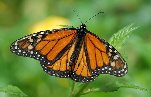
The Monarch (Danaus plexippus) was designated in 2000 (see Minnesota Statutes 1.1497).
Promoted by a fourth-grade class at Anderson Elementary School in Mahtomedi, Rep. Harry Mares and Sen. Chuck Wiger sponsored the bill to name the monarch butterfly as a state symbol. Rep. Mares noted, "A lot of people have an early introduction to the magical world of nature through the monarch, and as we get older it becomes a thread that takes us through science to beauty and aesthetics." Governor Jesse Ventura signed the bill into law.
Learn more:
Drink

Milk was designated the official state drink in 1984 (see Minnesota Statutes 1.1495).
Rep. Rick Krueger, chief sponsor of the bill, said that milk was chosen for several reasons; it has promotional value for the American Dairy Association, it would help tourism efforts, show the dairy industry the state cares about it, and bring about a general awareness of dairy products in the state. It was signed into law by Governor Rudy Perpich.
Flag
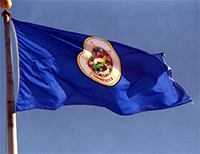
The first state flag was designated in 1893 (see Laws of Minnesota 1893, Chapter 16).
The design for the current Minnesota state flag was adopted in 1957 (see Laws of Minnesota 1957, Chapter 155, Sections 1-4), based on a proposed design by a legislative
interim commission created in 1955 (see Laws of Minnesota 1955, Chapter 632). Minnesota Statutes 1.141 describes the flag and conditions under which it should be flown.
In 1989, a new flag design was proposed by the Minnesota Flag Coalition, but no bill was introduced. In 2000, Sen. Ed Oliver introduced a bill (SF3587) proposing a
legislative task force on the design of the state flag, but the bill did not pass. Similar bills were proposed in 2006 (HF3974/SF3459), 2007 (HF1385/SF1454), 2018 (HF2728/SF2457), and 2019
(HF505/SF1763), but none of those bills passed.
In 2023 the Legislature established the State Emblems Redesign Commission, tasked with redesigning both the flag and the state seal (see Laws of Minnesota 2023, chapter 62, article 2, section 118). The Commission's final report detailed the new design for the flag and seal. A minority report was also issued. The flag and seal become official on May 11, 2024, unless the Legislature takes action before then (see Minn. Stat. 1.135 and Minn. Stat. 1.141).
Learn more:
- Becker, William M. "The Origin of the Minnesota State Flag." Minnesota History, 53 (Spring 1992): 2-8. Used with permission.
- Burnquist, Joseph A.A. (editor). Minnesota and Its People. (Volume 1). Chicago: S.J. Clarke Publishing, 1924, p. 327-328.
- Cook, Mike. "Two for One: State Flag Did Not Always Appear As It Does Today." Session Weekly, February 1, 2002: p. 4
- Moos, Grant. "New Wave: Two State-Flag Enthusiasts are Running a New Design Up the Flagpole." Minnesota Monthly, November 1989: p. 23-24.
- The New Official Flag and Great Seal: Report of the Minnesota State Emblems Redesign Commission to the Minnesota Legislature and Governor. St. Paul: Minnesota State Emblems Redesign Commission, 2024.
- Report of the Interim Committee on Change of the State Flag. St. Paul: The Commission, 1955.
Flower
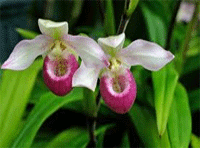
The pink and white Lady Slipper (Cypripedium reginae) was designated the state flower in 1967 (see Minnesota Statutes 1.142).
The Lady Slipper was considered the state flower long before it was officially passed into law. In 1893 a petition from the Women's Auxiliary to the World's Fair was presented to the Senate, asking that the Wild Lady Slipper (Cyprideum calceolous) be designated the state flower. The Senate adopted the resolution on February 4, 1893 (Senate Journal entry), but there is no evidence that the House adopted it. Also, the variety that was designated was not from Minnesota. In 1902 women of the St. Anthony Study Circle brought this to the attention of the Legislature. The Senate passed a new resolution on February 18, 1902, naming the pink and white lady slipper (Cypripedium reginae), also known as the showy lady slipper, as Minnesota's state flower (Senate Journal entries). The House concurred (House Journal entry).
The designation as official state symbol was written into law in 1967; chief authors were Rep. Jack Morris and Sen. John Tracy Anderson. It was signed by Governor Harold LeVander.
The Minnesota state flower is protected by Minnesota Statutes 18H.18. Information on transplanting lady slippers is available from the Minnesota Department of Natural resources.
Learn more:
- Flandrau, Charles E. "The Official State Flower of the State, and the Method of Its Selection," The History of Minnesota and Tales of the Frontier, St. Paul: E.W. Porter, 1900, pages 237-241.
- Lady's slipper: Information from the Minnesota Department of Natural Resources.
- Minnesota's State Flower: Queen of Lady's-Slippers. St. Paul: Minnesota Department of Natural Resources, Undated. (1976? It is part of the Minnesota Heritage Series.)
- "State Flower Called Fake: St. Anthony Study Circle Asserts Official Posie Does Not Grow Wild Here, Evidence is Submitted, Women Ask Senate to Make an Amendatory Resolution Changing to Another Species," Minneapolis Tribune, February 2, 1902: p. 6.
Fruit

Honeycrisp apple was designated the state fruit in 2006 (see Minnesota Statutes 1.1475).
The successful Honeycrisp apple variety, developed at the University of Minnesota, was suggested by a class of students from Andersen Elementary School in Bayport. Rep. Mike Charron and Sen. Brian LeClair sponsored the legislation and Minnesota became the 21st state to adopt a state fruit. It was signed into law by Governor Tim Pawlenty.
Learn More:
Gemstone
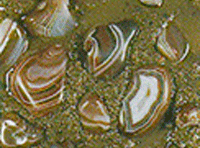
The Lake Superior agate was designated in 1969 (see Minnesota Statutes 1.147).
Though some legislators wanted to call the gemstone "The Minnesota Agate," Sen. Mel Hanson, sponsor of the bill, said that rock-hunting clubs in the state preferred keeping the name Lake Superior agate. According to one news account, members of the Senate General Legislation Committee debated for an hour over whether it should be the state rock, stone, or gemstone. Rep. Vernon Hoppe sponsored the companion bill; it was signed into law by Governor Harold LeVander.
Learn more:
Grain

Wild rice (Zizania aquatica) was designated the state grain in 1977 (see Minnesota Statutes 1.148).
Sen. Collin Peterson sponsored the bill in the Senate as a way of promoting the state and wild rice. Rep. Don Samuelson was the House chief author. Governor Rudy Perpich signed the bill into law. While designated our state grain, wild rice is actually a hardy aquatic annual grass.
Learn more:
- Wild rice: Information from the Minnesota Department of Natural Resources.
Motto
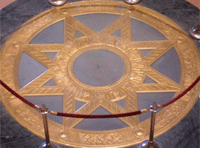
L'etoile du Nord (translated "Star of the North") was adopted formally as the official state motto in 1861. Henry Sibley selected this motto to be used on the state seal and the Legislature approved both the seal and the motto at the same time (see Laws of Minnesota 1861, Chapter 43).
Learn more:
Muffin

The blueberry muffin was designated in 1988 (see Minnesota Statutes 1.1496).
Representative Mary Murphy introduced the bill at the request of a third-grade class from South Terrace Elementary School in Carlton, Minnesota. The Senate companion was authored by Sen. Florian Chmielewski. The third graders were inspired by a Massachusetts class who lobbied for the corn muffin to become an official symbol in that state. The Minnesota school children chose the blueberry muffin because wheat is an important crop in southern Minnesota and wild blueberries are common in northern Minnesota. Governor Rudy Perpich signed the law.
Mushroom
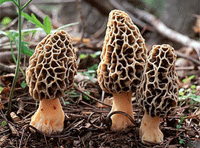
The morel mushroom (Morchella esculenta), commonly known as the morel, sponge mushroom, or honeycomb morel, was designated in 1984 (see Minnesota Statutes 1.149).
Minnesota was the first state to have an official state mushroom. Sen. Gary Laidig and Rep. Connie Levi were chief authors of the bill, which was suggested by the Minnesota Mycological Society. Governor Rudy Perpich signed the bill into law.
Learn more:
Photograph
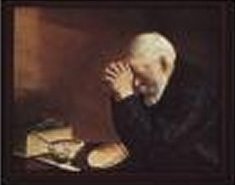
"Grace" was designated in 2002 (see Minnesota Statutes 1.1498).
The bill to designate "Grace" as the official state photograph was sponsored by Sen. Bob Lessard and Rep. Loren Solberg. Rep. Solberg lived in Bovey, the town where the photograph was taken in 1918 by Swedish Immigrant Eric Enstrom. Governor Jesse Ventura signed the bill into law.
Learn more:
Seal
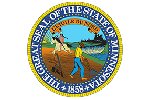
The official Minnesota state seal was adopted in 1861. Minnesota Statute 1.135 describes the seal, its historical symbolism and its uses. Until 1974, the Minnesota Constitution required that the seal "shall be attached to all official acts of the governor requiring authentication."
In 1849, Henry Sibley proposed that a picture created by Seth Eastman be adopted as the official Minnesota territorial seal. This proposal was adopted by the legislature. When Minnesota became a state in 1858, officials continued to use the territorial seal until 1861 when Minnesota Laws 1861, Chapter 43 was passed, creating an official state seal. The 1861 seal showed a settler plowing a field beside the Mississippi River near St. Anthony Falls. In the background, an Indian on horseback rides toward the setting sun. A banner shows the state motto "L'Etoile du Nord". In 1983 the seal was redesigned (Laws of Minnesota 1983, Chapter 119). Norway pines (the state tree) were added behind St. Anthony Falls and the direction of the Indian was changed. He now rides toward the farmer rather than away from him.
In 2023 the Legislature established the State Emblems Redesign Commission, tasked with redesigning both the flag and the state seal (see Laws of Minnesota 2023, chapter 62, article 2, section 118). The Commission's final report detailed the new design for the flag and seal. A minority report was also issued. The flag and seal become official on May 11, 2024, unless the Legislature takes action before then (see Minn. Stat. 1.135 and Minn. Stat. 1.141).
Learn more:
Song
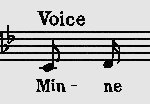
"Hail Minnesota" was adopted as the Minnesota state song in 1945 (see Laws of Minnesota 1945, Joint Resolution 15). The chief authors were Rep. Ben D. Hughes and Sen. Val Imm. Prior to this, at least one other song had been proposed as the state song. In 1919, the Legislature passed SF825 which would have established "My Minnesota," by L.Y Lenhart and Juila M. Rogers, as the state song. But Gov. Burnquist vetoed the bill.
Written in 1904, "Hail Minnesota" was a song in a University of Minnesota play, "The Apple of Discord." "Hail Minnesota" was used as the alma mater for the University of Minnesota and later adapted for use as the official Minnesota state song (see sheet music). One change was made to the words. The second line of the song, "Hail to thee, our college dear" became "Hail to thee, our state so dear."
"Hail, Minnesota"
Minnesota, hail to thee!
Hail to thee our state so dear!
Thy light shall ever be
A beacon bright and clear.
Thy sons and daughters true
Will proclaim thee near and far.
They shall guard thy fame
And adore thy name;
Thou shalt be their Northern Star.
Like the stream that bends to sea,
Like the pine that seeks the blue,
Minnesota, still for thee,
Thy sons are strong and true.
From thy woods and waters fair,
From thy prairies waving far,
At thy call they throng,
With their shout and song,
Hailing thee their Northern Star.
Sport

Ice hockey was named the official state sport of Minnesota in 2009 (see Minnesota Statutes 1.1499).
Sen. Gen Olson first introduced a bill to designate hockey as the state sport in 2007 (SF2313). It was suggested by sixth-grade students at Minnetonka Middle School East, who spent months collecting more than 600 signatures in support of the proposal. Co-author Sen. David Tomassoni had ties to the sport; he played professional hockey in Italy for several seasons, and played on the Italian team in the 1984 Olympics. The House chief author was Rep. John Berns, along with fifteen co-authors. (HF3771) It was signed into law by another hockey fan, Governor Tim Pawlenty.
Learn more:
Tree
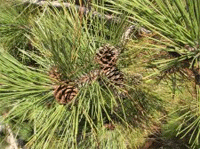
The red or Norway pine (Pinus resinosa) was made official in 1953 (see Minnesota Statutes 1.143).
Through the efforts of the Friday Study Club in Minneapolis, and backed by the Minnesota Federation of Women's Clubs, the Norway pine designation was passed in 1953. It was sponsored by Sen. Gordon H. Butler and Rep. George A. French, and signed into law by Governor C. Elmer Anderson on February 18, 1953. The language of Chapter 20 noted the sturdiness and majesty of the tree, and how it helped lay the foundation for the wealth of Minnesota.
Learn more:
- Norway pine: Information from the Minnesota Department of Natural Resources.